Rebuild WNC
Recruit. Train. Retain.
A skilled trades pilot to put Western North Carolinians to work rebuilding Western North Carolina.
Western North Carolina has years of rebuilding ahead after Hurricane Helene. Securing recovery funding is essential, but we also need enough trained workers here to turn those dollars into repaired roads, bridges, homes, utilities and communities.
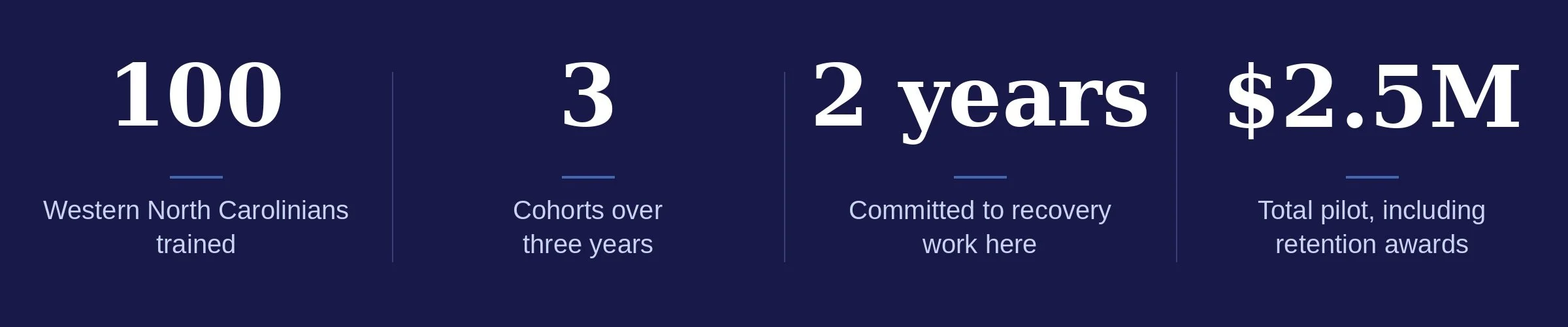
That is the idea behind my Rebuild WNC Skilled Trades Pilot Program. The proposal would recruit 100 Western North Carolinians, help them complete training for skilled trades needed in Helene recovery, and provide incentives for them to stay here and put those skills to work rebuilding our region.
-
Hurricane Helene left Western North Carolina with years of work ahead. Roads, bridges, culverts, homes, utilities and community infrastructure still need to be repaired or rebuilt. Our job is not only to secure state and federal money. We also have to make sure there are enough trained people here to turn that money into actual work.
The workforce has not kept pace with the damage. Western North Carolina lost about 19,000 jobs in the month after Helene, according to the NC Department of Commerce.[1] An NC Rural Center analysis found that the construction workforce in the Helene region shrank during the first two quarters after the storm and did not begin growing again until the third quarter. After Hurricane Florence, by comparison, the eastern North Carolina construction workforce grew for three straight quarters.[2] Local governments in the region are also short on staff and resources.[3]
-
I propose a small pilot that trains 100 Western North Carolinians for skilled jobs tied to Helene recovery and the region's longer term infrastructure needs. The idea is simple: help people finish training that already exists, remove the practical barriers that keep them from completing it, and connect them directly to paid apprenticeships and jobs in recovery work.
Training could include heavy equipment operation, commercial driving, diesel technology, surveying and civil engineering support, welding, electrical work, plumbing, HVAC, carpentry, masonry, utility line work and related construction skills. Jobs could be with NCDOT, local governments, utilities, nonprofit recovery organizations or private contractors doing approved public infrastructure and housing recovery work.ext goes here
-
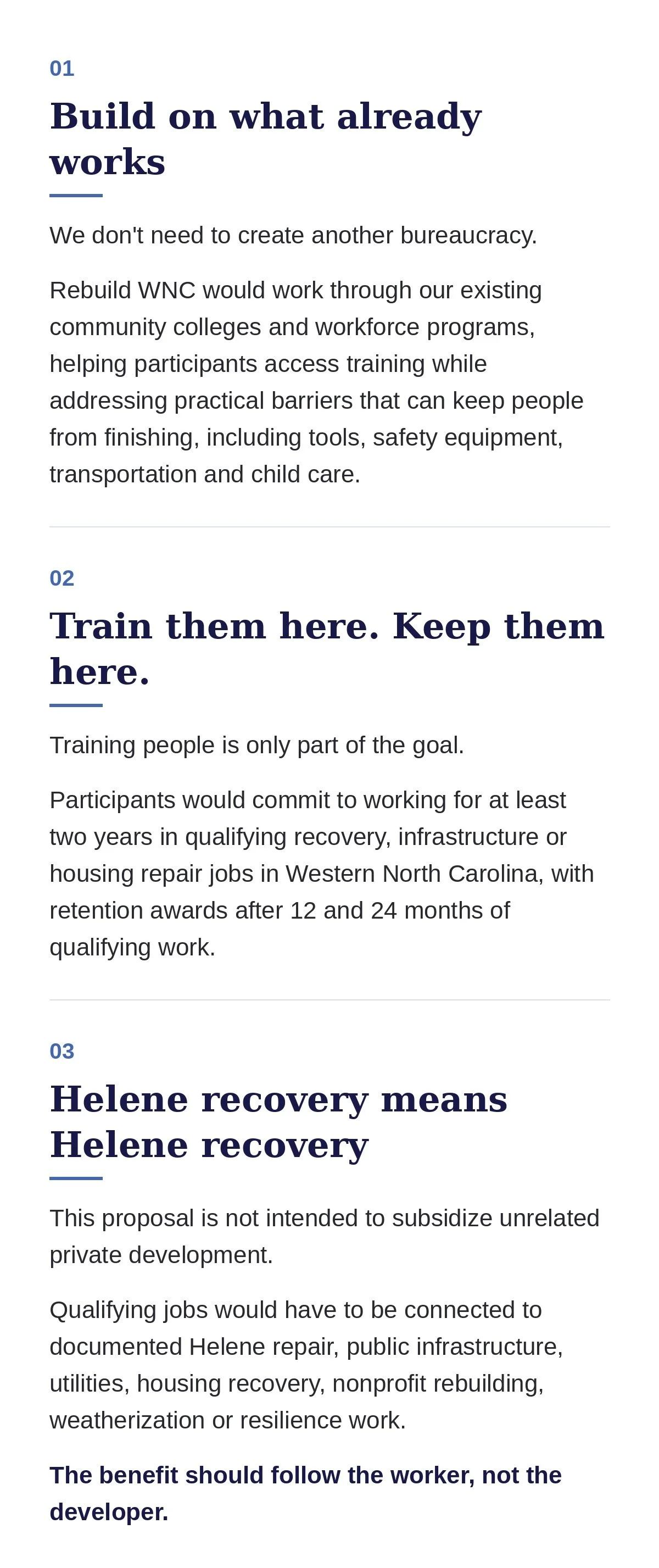
This pilot does not create a new school or a new bureaucracy. It would plug into the network we already have: Blue Ridge Community College, A-B Tech and the other Western North Carolina community colleges, along with NCWorks, ApprenticeshipNC and Good Jobs WNC.
Good Jobs WNC is an important foundation. The coalition spans 23 counties, 11 community colleges and 48 employer partners, and recently announced $3.2 million in grants to the region's colleges to help connect 1,200 residents to good jobs over three years.[4] Those grants focus on building and expanding training programs across health care, manufacturing and the skilled trades.
The state has also used federal disaster workforce money. A $10 million U.S. Department of Labor Disaster Recovery Dislocated Worker Grant, run by the NC Department of Commerce with five local workforce development boards, has paid for temporary cleanup and recovery jobs and for training, including at community colleges.[5] In its September 2025 federal funding request, the state also asked for $20 million for accelerated short term training at community colleges in disaster affected regions and $2 million to expand apprenticeships through ApprenticeshipNC.[6]
Rebuild WNC would complement that work, not duplicate it. It would focus on a smaller group of people in recovery trades and add what program grants usually do not cover: help with individual costs, paid work based learning, and incentives to stay in recovery jobs here for at least two years. Participants could enroll in programs that Good Jobs WNC is already helping colleges build.
-
The work would be split between two agencies that already do these jobs. The North Carolina Community College System, which oversees all 58 community colleges and houses ApprenticeshipNC, would lead training, financial aid and apprenticeships.[7] The NC Department of Commerce, through NCWorks and the local workforce development boards, would approve employers, verify employment and pay retention awards. Commerce and the local boards already run the state's federal disaster workforce grant, so they have experience verifying Helene recovery jobs.
I would pursue funding through a state budget appropriation. I would also seek to combine it with federal workforce and disaster recovery dollars and private philanthropy where the rules allow. The state share could shrink as other sources come in.
-
Community college can be low cost, and financial aid makes it free or nearly free for some students. But aid varies a lot by program type.
The Next NC Scholarship covers students in degree, diploma and certificate programs who meet income and financial need limits, including household income of $80,000 or less.[8] Many of the fastest routes into recovery work, such as commercial driving or short term equipment and trades credentials, are noncredit workforce programs. Those generally do not qualify for Pell Grants or Next NC. The state's Short Term Workforce Development Grant helps, but it is capped at $750 per course.[9]
That gap is why the pilot would use existing aid first, then cover remaining tuition and fees. It would also pay for the costs that often keep people from finishing: tools, safety equipment, transportation and child care.ription
-
Who is eligible: 100 adults who live in North Carolina counties covered by the federal Helene major disaster declaration, with priority for Western North Carolina residents.
Enrollment: Three cohorts enrolled over three years.
Commitment: After training, participants agree to work at least two years in an approved recovery, infrastructure or housing repair job in Western North Carolina. Changing between approved employers would count.
Retention awards: $2,500 after 12 months in qualifying work and $5,000 after 24 months.
If someone leaves early: They do not receive awards they have not yet earned. They would not owe repayment for leaving because of layoff, illness, disability or family hardship. Repayment would apply only in cases of fraud.
Job standards: Qualifying jobs would have to meet a wage standard set with the colleges and workforce boards before launch, and participants could not be used to replace existing workers.
Accountability: Before launch, the pilot would set public goals for completion, placement, wages and retention. The state would track credentials earned, job placement, wages, retention and the projects participants worked on. It would publish the results and compare them with similar students who did not take part.
-
Training takes different lengths of time in different trades, and the commitment is two years of work after training. So the pilot would run in two phases: three years to enroll and train participants, then two more years to track retention.
First six months: Bring together colleges, workforce programs, NCDOT, local governments and employers. Confirm which occupations have real demand, set eligibility rules and recruit the first cohort.
Months 6 through 36: Enroll three cohorts. Begin paid work based learning and apprenticeships as participants are ready, and place graduates in qualifying jobs.
End of year three: Publish an interim report on enrollment, completion, credentials, placement and wages, so lawmakers have early results before deciding on expansion.
Years four and five: Continue retention support and awards for later cohorts. Publish a final evaluation of two year retention and results.
-
A reasonable planning estimate is $2.5 million over the life of the pilot for 100 enrolled participants, an average of $25,000 per person. That is more per person than a typical program grant because it covers individual costs that often keep people from finishing training, along with incentives to stay in recovery work. About 30 percent of the budget is retention awards, which are paid only after someone has worked 12 or 24 months in a qualifying job.
Up to $500,000 for tuition, fees and credential testing not covered by other aid
Up to $450,000 for tools, safety equipment, transportation and child care
Up to $200,000 for apprenticeship support for small contractors, local governments and nonprofit rebuilders that need help covering supervisor and mentor time
$750,000 for retention awards, at most $7,500 per participant
Up to $300,000 for college instructors, equipment and added training seats, focused on expanding programs that already exist
$300,000 for administration, fraud prevention and an independent evaluation
Wages would be paid by employers or the funded recovery projects, not from this budget. Retention awards that go unearned, and any unspent funds, would return to the state. The program would also help participants understand how awards affect taxes and benefits. This is a planning estimate, not a fiscal note.
-
The benefit should follow the worker, not the developer. Qualifying jobs must be tied to documented Helene repair, public infrastructure, utilities, publicly supported or HUD housing recovery, nonprofit rebuilding, weatherization or resilience work. Speculative subdivisions, luxury construction, vacation rentals, house flipping and unrelated commercial development would not qualify.
Apprenticeship support would go only to employers doing qualifying work, and it would be limited to the cost of training workers, not general business expenses. Employers would document wages, payroll and the projects involved. Fraud by a participant or an employer would trigger repayment and exclusion from the program.
-
Helene recovery will take years, and more storms and infrastructure needs are coming. As recovery dollars reach Western North Carolina, we need people ready to do the work. People trained through this pilot could spend decades repairing roads and bridges, building and maintaining homes, strengthening utilities and helping communities prepare for the next disaster. They would also gain portable skills, better pay and a reason to build their lives here.
This pilot is small enough to test, large enough to produce meaningful results and built around institutions that already exist. If it works, the state will have the data to expand it. If it does not, we will know that too, at a modest cost.
Sources
1. WFAE, "Two years after the storm: Hurricane Helene recovery," September 26, 2026. https://www.wfae.org/energy-environment/2026-09-26/two-years-after-the-storm-hurricane-helene-recovery
2. NC Rural Center, Helene Housing Recovery report, January 2026. https://www.ncruralcenter.org/wp-content/uploads/2026/01/helene_housing_recovery.pdf
3. ProPublica, lessons for the Hurricane Helene housing recovery program. https://www.propublica.org/article/hurricane-helene-housing-recovery-program-lessons
4. EdNC, "Ahead of the anniversary of Helene, Good Jobs WNC expands funding to invest in the workforce of the future," September 24, 2026. https://www.ednc.org/9-24-2026-ahead-of-the-anniversary-of-helene-good-jobs-wnc-expands-funding-to-invest-in-the-workforce-of-the-future/
5. NC Department of Commerce, "Governor Stein announces more funding for temporary jobs, training for Helene recovery," October 24, 2025. https://www.commerce.nc.gov/news/press-releases/2025/10/24/governor-stein-announces-more-funding-temporary-jobs-training-helene-recovery
6. NC Office of State Budget and Management, Helene federal funding request, September 2025. https://www.osbm.nc.gov/helene-federal-funding-request-sept-2025/open
7. NC Community College System, About ApprenticeshipNC. https://www.nccommunitycolleges.edu/businesses/apprenticeships/about/
8. NC Community College System, Next NC Scholarship. https://www.nccommunitycolleges.edu/students/paying-for-college/options-for-paying-for-college/scholarships/nc-scholarship/
9. N.C. Gen. Stat. 115D-5.1A, Short Term Workforce Development Grant Program. https://www.ncleg.gov/EnactedLegislation/Statutes/PDF/BySection/Chapter_115D/GS_115D-5.1A.pdf